The Good Wife Gets Out in The Last Mrs. Parrish

By Liv Constantine

Greed and domestic violence are the central points in Liv Constantine’s The Last Mrs. Parrish. The story tells the lives of two women who are at the opposite ends. One seems to have it all and the other has nothing.

Amber, whose real name was Lana Grump, pitied her life- a life that came from nothing, schemed up a plan to get close to Jackson Parrish to seduce him. Amber befriended his wife, Daphne Parrish. Slowly, Amber infiltrated the Parrish’s lives and established a place in the family.

As Amber tried to get close to Jackson Parrish, Daphne tried to get far away from him. Daphne was suffering from the abuse of Jackson’s controlling behavior. Daphne was coming up with her own scheme.

Two women, two plans. Both succeeded.

This is one of the most satisfying ending novels. The antagonists get what they deserved, and the protagonist broke free.

The book did have a slow warming to me. The book started about with Amber and her dirty scheme for one third of the book. I was rooting for the unknown protagonist and her avenge. But as the pages turned, I get a satisfying ending.

100% recommended!

​YOU’LL FIND LOVE AT THE OTHER SIDE OF THE BRIDGE

the other side of the bridgeWhen I was a young girl, I loved bridges. My small village in Vietnam was crisscrossed by rivers and streams, and bridges allowed me to cross over to the other side. Of course, they were primitive bridges. Most of the bridges were long trees that were placed from one side of the river to the other side; or ropes that were tied to one strong tree on one side connecting to another tree on the other side.  These bridges were not built with metal or concrete, but they were strong enough for me to cross over to the other side each morning and return in the early evening. bridge

Here in America, bridges are much bigger, stronger, and more magnificent. Sometimes they are so tall they give me chills as I drive my car on them.  It does not matter where I live, I still think bridges represent something magical and beautiful. Bridges symbolize unity, continuation, and hope. I feel a connection and find these traits when reading Wright’s The Other Side of the Bridge. Wright stated the exact sentiment on page 316 “ …the bridge of magic, the bridge of hope…”

The Golden Gate Bridge is the center. On the east side, Wright placed Dave Riley as a desperate executive searching for hope after an accident took his family away. On the west side, Wright crafted Katie Connelly, a young and hopeless research intern finding magic to move forward with life after the death of her father and betrayal of her fiancé. You would think these two would fall in love and live happily.

golden gate bridgeWell, maybe in another version, on a different bridge. This is why Wright’s clever craftmanship takes me by surprise. They both found what they were hoping for by racing through the bridge, but not the way I expected. Half-way through the book, I found myself screaming at Wright: “When are you going to let them meet?”  They met alright. But briefly. Unrecognizable like two ships passing through the moonless night on the San Francisco Bay. As I read through the pages, I was hoping for a longer chapter so these two star-crossed people could dig deeper into their connection. However, bridges do not run on forever.

Wright did not focus on despair, lost, hope, or love. He retold realism. Take the Vietnam Memorial for example. I lived in the suburban near Washington D.C. and every chance we get, we would go to D.C. and of course, my favorite site is the Vietnam Memorial. Looking at it from a distance, it is just a wall, concrete, hard, tall. But as I walked closer to it, and run my fingers on it, it is no longer a wall, but sentiments, lost lives, unsung heroes. Emotions would swell inside me. There is magic there at that Memorial. Wright described the exact sentiment in the voice of Redd and Dave. I wonder how many times he had been there and feel the wall.

In our lives, there are walls that separated us. Then there are bridges that connected us. I invite you to read The Other Side of The Bridge and find those connections.

A Learning Journey with Rain Reign

It was the first day of school for my daughter. She came home excitedly announced that she had the same teacher as in third grade, and 13 out of 22 students were in third grade last year.  “And who are the other students,” I asked.

She tried to remember their names and whose classes they were from.

“But mommy,” she said. “I don’t think I am in a smart class because there are kids with aides in my class.”

She clarified that her class had three kids with aides. They were autistic students who needed more help in keeping calm and paying attention in the class.

One student occasionally yelled out in the class.

They sat in the back of the classroom with their aides, trying to be invisible to the class.

“What makes you think autistic students are not smart?”

She shrugged her shoulder.

I thought this is a good opportunity for her to learn more about Autism and autistic friends.

We picked up the book Rain Reign.

rainreign

We read it together.

At first, it was not holding her interest. But as we read deeper into the book, and as she spent more days with her autistic classmates, she could relate to the story, and she showed more interest in it. She wanted to finish the book the next day, but we decided to read it slowly and learn more about events in the book.

Rain Reign could not have come at a perfect time.

We learned more about high functioning autism, which was the diagnosis of Rose, the main character in the story.

When we read the part where Rose got upset and started crying: when she observed the cars did not follow the rules (p. 35), and when Josh did not follow the grammar rule ( 41-42). My daughter thought back of her classmates. She understood why Adam shouted out in the class, why Jean cried for ‘nothing’ which was for something, and why Kaily just bounced back and forth.

We looked up Hurricane Susan, which was mentioned in the story, and found it happened in 1958 and 1969, which probably was not the one in the story. Only we reached the end, we found out it was indeed hurricane Irene that inspired the story. We read more about Hurricane Irene and its destruction.

We reviewed prime and composite numbers (These are common core standards!)

We had our lessons on homophones, homographs, antonyms, and synonyms. We did not make the list like Rose, but we ended up with the poster of these colloquialisms.

The book did nothing for me if I was to read it by myself. But reading it with my daughter and turning it into teachable moments made it absolutely meaningful.

The most meaningful thing my daughter learned that we could be identified as autistic and still be smart. “Mommy,” she said, “Adam is very smart with the computer.” She was able to look past the labeling and recognize their true smarts. We all have our talents.

I Challenge You…

Every morning we wake up, not everyone but I sure do, we scroll thru Facebook and read quick updates about friends and family.  Between all the pictures of kids playing and news reports, I saw one of a book cover. My friend was invited to post on Facebook each day for seven days a little bit about a book that inspired her to start reading or has made an impact on her life.  I thought this was a wonderful idea and loved that each day you could challenge a friend to join. This may sound like one of those annoying posts that clutter your feed, but to me, it was a peek into my friends’ bookcase and a little note about why that book still sits on the shelve all these years.

I was finally challenged and was already prepared with a book. I was about to post and then realized something- that the more I thought about it, the book I picked was something that was an important book, but it wasn’t the book that inspired me to read.

I sat on my bed, with my phone on my lap and took a little moment to search all my memories of when I had time to sit back and read a good book. I can tell you it’s not many, as a mother of two very active boys, I get to read but not as much as I would really like. Then it hit me, that moment when I laughed, cried and learned all at the same time. The first book that actually made me want to keep exploring the world of paper and typed words.

I’m only on day 4 of this challenge and I have been loving looking back and remembering the wonderful stories that those books have brought to my life.  Many that I would love to read again and to bring back that feeling they bring by only looking at the covers.

Here is the post on my Facebook- and I challenge everyone who is inspired to copy and share their love of books with everyone!

Day 1/7 Book Challenge 📚 📖 (I was challenged by Lille Marie Arosemena )
For the next week, I will be posting the cover of books that I’ve enjoyed along with a little bit about why I love them so much.

In addition to that, I will be inviting a friend to join the challenge on a daily basis. To those who are up to the challenge, please post the cover from one of your favorite books each day. Whether you wish to include an explanation or not is up to you.

I grew up speaking Spanish. When I was 3 I went to Private school and I was taught English. I read Frog and Toad are friends. It was my first successful read and in English. As I was growing up my parents noticed me confusing words and letter- they chucked it up to the fact that I was mastering two languages. Then my mom saw my preference to use my left hand for playing jacks. I was diagnosed with Dyslexia at a later age and back then assistance wasn’t big in Latin America.
I was never a fan of reading- I was traumatized as I had to read in front of the class and I was made fun of for making mistakes. (That’s my side trauma of why I hated school).
My dad traveled and would buy me books. This is the book that got me into reading- Judy Blume.
I would Read all her books with glee! Then reading became something I loved for myself and not for school.
If it wasn’t for my Dads love of books and his love for me to love reading- I doubt I would still enjoy a good book.

So here is one of my many favorites.

Image result for it me god margaret

Hurray For Teachers

In our lives, we all had a wonderful teacher or two who made a lasting impact. In every society, we all glorify the role of teachers and their paramount impacts. We send our kids to them each day, hoping they would teach them to be a president, a famous doctor, or a skillful engineer. We entrust our children and their future to these dedicated teachers.  Yet, we pay them so little and they have to fight to get a raise to cover their monthly bills.

Here to all the teachers.  WE STAND BY YOU!

merlin_61071931_505d11d0-c13f-4a43-acf6-8d462dfbb68f-master675

And if you wonder what it is like to be a teacher. I would like to share with you a small excerpt from Al Parker.

Teachers are special people. They’re different and maybe even a little strange.  They’ll take a trip just to visit a library.”

“Have you even seen a teacher’s car? It’s a combination bus, U-Haul trailer and filing cabinet on wheels.  To a teacher the trunk isn’t there to hold spare tires.  It’s there to hold science projects, book reports, and models of the White House made out of cubes of sugar.”

“They’re strong.  One little, skinny kindergarten teacher can carry more than a 20 years-old combat Marine can and she can do it while singing “Eency Weency Spider.”

“Teachers love books and they love to buy them.  There are bookstore owners all over America who are able to take European vacations just because of them.”

“A teacher can correct a stack of papers, yell at a kid, answer the phone, argue with the custodian, and eat her lunch at the same time.”

“She can do this because her stomach turned to concrete years ago from eating all that cafeteria food.”

“Anything can happen.  Don’t be surprised if someday you get a call from the Police Department telling you that your mate has been picked up going through the neighborhood trash.”

“Teachers have been known do this, even respectable, gray haired ones with master’s degrees.  They do this because they need those cans, labels, and newspapers so that they can get money to buy things for their classrooms.”

“Do you like snakes? Do you like feeding a thousand guppies that started out as just two? Do you enjoy finding silk worms in your refrigerator?  Do you like having bean and avocado seeds sprouting all over the place and do you like strange things made out of coat hangers and egg cartons?  If you’re married to a teacher, you better get used to it!”

“It’s hard for teachers to say no.  They give up a lot.  They give up their time, their energy and sometimes even their sanity. Life can be hard for them because they care.”

“So, if you meet one, be kind.  They can’t help it.  They’re just trying to make the world right.  They just want everyone to be better.  They believe that each of ushas a responsibility to discover our talents and perfect them.”

“Teachers act like teachers because that’s the way they are. It’s kind of a disease, but such a wonderful disease.  It’s too bad more people don’t catch it.


Is ESCALATE The New Paradigm in Education?

I got bad news.   

My nephew quit school. He was a year away from his Bachelor’s degree in Computer Engineering. Last week, when all of his friends were excitedly coming back to their Senior year, he decided to drop out and work full time at a Coffee shop instead.

His decision was a big shock to my sister, who left everything in our country to immigrate to the United States so that my nephew could get a better education, a college degree. She was hoping for a degree in law or medicine, but engineering would be fine, too.

Her dream was shattered.

She turned to me who is an educator by training and who always touted that education could truly free us. I called my nephews early in the morning before the early morning coffee rush takes over his time.

“I don’t see why I should get my degree. I don’t really learn anything in my classes. All day long my professors talk and talk. I barely stay awake in class, and after three years I don’t remember anything.  And what am I to do with a degree? I see all my friends who have already graduated ended up working in Fast Food restaurants or Starbucks with their BS. I am just getting a head start.”

Is that true? All we do is lecture? And lecture? I went back to the college where I taught and watched the video I recorded earlier in the spring semester for staff reflection. To my dismay, I found that during 2.5 hours of class time, I spoke for the total of 1 hour and 47 minutes. The other 43 minutes consisted of 10 minutes break, and 20 minutes independent work. My students rarely had the experience to share their thoughts, work with fellow students, and speak out!

Yes. I agreed. I was a pretty bad instructor. But wait before you judge me, walk to any classroom and observe first. Sadly, traditional classroom lecture, professor talks-students listen, is the trend you see mostly in any educational institutions.

“We don’t teach like that!” said Dennis Grimsley when I shared with him about the current teaching methodology while I was drinking coffee at the local Starbuck. It was a chance encounter that opened my eyes to a new possibility that might impact educators like myself.

cognitive-computing-1

Dennis Grimsley is a cofounder of Point3 Security and one of the creators of ESCALATE, the most anticipated and hyped software in cybersecurity world that will be released in November of 2017.

I was a little apprehensive. What does a computer expert know about teaching methodology?

Turned out, he knows a lot.

“When designing ESCALATE, we moved away from college cramming and pouring information to students. We provide real-life challenges. We mentor them, but they have to develop goals and strategies by themselves.”

“Like Kolb’s learning theory, ESCALATE provides experience-based learning that is meaningful to the students. Students are actively engaged. They will struggle through the challenges in the program. But they have time and opportunities to discover and create the answers. They observe, reflect, and acquire the learning. ”

I noticed he used “acquire.”

“Because when you struggle and have hands-on, experiential learning, the knowledge you gained will stay with you. With traditional classroom learning, you remember the contents for the test, then you forget everything the day after.”

It did not take an expert in education to know why our education system is failing. It did not take an expert in education to provide a solution.

Interesting enough, it took a computer engineer! Maybe we should hire a cybersecurity engineer to run the U.S. Department of Education!

Why?

Because the learning model, like the experiential-based model that ESCALATE modeled after, involves the students as a whole: the cognitive, affective, and physical are stimulated.

Because the challenges offer real-life experiences and different ways to solve them. There is no one correct answer.

Because the challenges offer a long lasting impact. Students retain the knowledge after years of leaving the program because what they acquired is personal, relevant, and practical.

Aren’t these the ultimate goals of our education? But our educational system is failing because the teachers, like myself, are trained in traditional teaching method. We lecture on and on, while our students are disinterested and lost.

Until we change our  teaching methodology, we will not be able to produce talented graduates. There will be many who quit school because they find no purpose in it.

Today, I reflect upon my teaching styles and embark on the experiential learning that ESCALATE modeled after.

And yes. I do think ESCALATE can impact the way teachers teach and students learn. I look forward to the launch of this software and see if it can take education into the Cyberspace.

The Idiomatic Problem of English Language Learners

After endless browsing through Netflix streaming for a title to see, I decided to settled with ‘Hot Pursuit.’ I thought Sofia Vergara and Reese Witherspoon would be entertaining for an hour and thirty minutes. It was the most intolerable and annoying one hour and thirty minutes I spent. But at last, there was one part in the movie that was very interesting, especially for English language learners.

I name this part: How colloquial language can bring down one’s career.

In the movie, Rose Cooper, played by Reese Witherspoon, was a righteous police officer. During one of her patrol shift, she followed a group of young and loud students partying. As they were leaving the party, one student shouted: “I got shotgun!”[1] Immediately, Cooper tackled, attacked, handcuffed, and arrested the student on the premise that he carried a weapon. She was demoted to an evidence room clerk as a result of her erroneous arrest.

As an English Language learner, I sympathized with Cooper. I also felt relief. The embarrassment of taking idiomatic language literally is not only the problem of English language learners, but for native speakers as well. The abilities to use and understand idioms are not innate. They are learned and acquired just like learning a second language.

I remembered my first year in college, right after I came to America. We were having a study group in which I shared my experience as an immigrant. I spent over thirty minutes lamenting how life was difficult for immigrant: the new language, new social norm, and new technologies to learn. I concluded that at the end, to survive, we all have to adapt and assimilate. One of the girls in my group nodded continuously and said, “you can say that again.”[2] So I started telling them my experience as an immigrant all over again. Nobody raised a voice to protest or explain.

Recently, at a social gathering with a few of my neighbors, one of my neighbors was sharing her wedding experience. She said if she was to do it all over again she would not have put on “a dog and pony show.”[3] In amazement, I asked excitedly, “Did you really have a dog and a pony at your wedding?” I could feel all eyes were on me. This time, it was explained to me that it was a figurative speech, not really a dog and a pony.

These are two examples of my many idiotic-idioms embarrassment in the course of learning and speaking English. I remembered in a fifth grade classroom, I observed students would spend a unit learning about idioms, and how and when to use them. “To add color to your language,” justified the teacher for teaching the unit. “To save you from lots of embarrassment,” I would have added. It is estimated that there are at least twenty five thousand idioms in the English language. Whew… They should have a full course on teaching idioms. A few days unit will not equip the students the tool to unravel the arbitrary of English idioms.

Here are some examples that I think English language learners should know:

  1. Break a leg: Good luck
  2. Get out of hand: get out of control
  3. Hang in there: Don’t give up
  4. No pain, no gain: You have to work hard for what you want
  5. Under the weather: Sick
  6. Costs an arm and a leg: Very expensive
  7. Take a rain check: Postpone a plan
  8. When pigs fly: Something will never happen
  9. Got up on the wrong side of the bed: Someone is having a bad day
  10. Until the cows come home: For a very long time

[1] When three or more people are to ride in a car, one of the non-drivers will often “call” shotgun, meaning that they get the privilege of riding in the passenger seat.

[2] You can say that again: to express strong agreement with what someone has just said.

[3] Dog and pony show: a highly promoted, often over-staged performance, presentation.

The Curriculum Fable

Around this time of the year, the school is sending home student interim reports with grades and comments about their learning development.  Like any parents, I am filled with excitement and anxiety about my child’s early progression in his learning. My eyes quickly scan the report, pausing at the ‘failing’ grades. A failing in Art Knowledge and Skill? Wait. Is that even a subject? How do you grade an art skill? I know he inherits my artsy genes and probably never excels beyond stick figures, but I still hope somehow he passes second grade art with confidence gained from instructional support.

While I contemplate on my child’s failing art grade, my friends lament on Common Core and its whole standards. They send me endless memes and posts of how silly our learning curriculum has become.  The pleads from parents to move away from Common Core are buzzing the webs, yet, tomorrow, when our children walk into the classroom, they again will be taught the oddest way to solve a simple math problem.

While reading about Common Core, I remember a fable written by Dr. Reavis.  I’d like to share it with you.

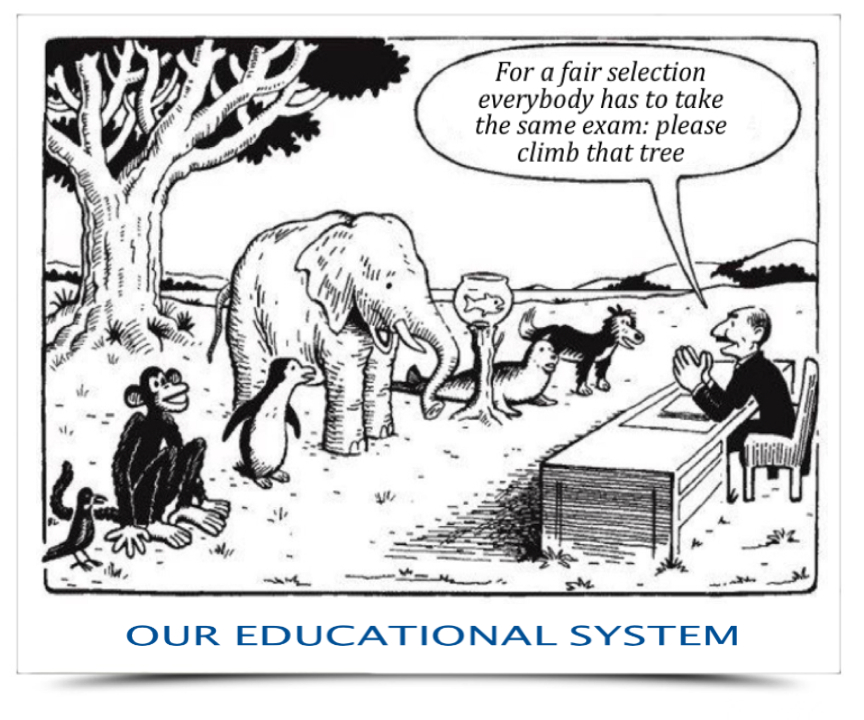
curiculum-fableBY Dr. G.H. Reavis

Once upon a time, the animals decided that they must do something “heroic” to meet the problems of “a new world.” So they organized a school.

They adopted an activity curriculum consisting of running, climbing, swimming, and flying. To make it easier to administer the curriculum, ALL the animals took ALL the subjects.

The duck was excellent in swimming, in fact better than his instructor; but he made only passing grades in flying and was very poor in running. Since he was slow in running, he had to stay after school and also drop swimming in order to practice running. This was kept up until his web feet were badly worn and he was average in swimming. BUT AVERAGE WAS ACCEPTABLE IN SCHOOL, SO NOBODY WORRIED ABOUT THAT EXCEPT THE DUCK.

The rabbit started at the top of the class in running, but had a nervous breakdown because of so much make-up work in swimming.

The squirrel was excellent in climbing until he develop frustration in the flying class where his teacher made him start from the ground up instead of from the tree top down. He also developed “Charlie horses” from overexertion and then got C in climbing and D in running.

The eagle was a problem child and was disciplined severely. In the climbing class, he beat all the others to the top of the tree, but insisted on using his own way to get there.

At the end of the year, an abnormal eel that could swim exceedingly well, and also run, climb, and fly a little had the highest average and was valedictorian.

The prairie dogs stayed out of school and fought the tax levy because the administration would not add digging and burrowing to the curriculum. They apprenticed their child to a badger and later joined the groundhogs and gophers to start a successful private school.

DOES THIS FABLE HAVE A MORAL?

“The Orphan Master’s Son” Becomes A Master

Johnson. A. (2012). The orphan master’s son. New York: Random House.

The Orphan Master’s Son is divided into two parts. Part one describes the life of Pak Jun Do, a child of a singer who disappeared, and an orphanage master of Long Tomorrow in North Korea. Growing up in the orphanage, Jun Do was familiar with hunger and famine. He taught himself to survive in harsh conditions and starvation. At the age of fourteen, Jun Do joined the army to be a tunnel soldier in which he learned to combat in darkness, a skill that later helped him in his military career. He performed many jobs for the army: kidnapping, language translator, and signal spying. While he was working as a signal spy on the fishing boat, his life began to take a different course.

Part two, which was told by an investigator in Division 42, is about how Jun Do assumed a new identity. Jun Do became Commander Ga, a Tae Kwon Do golden belt winner, a successful commander with a wife and two children. Jun Do fell in love with his ‘replacement’ wife, Sun Moon. Jun Do planned an escape to save Sun Moon and her children at the cost of losing his life.

Though some people claimed the book to be “ridiculously funny” or “comedic,” it was a sad and heavy reading for me. It took me a while to finish this book. I picked it up, read few pages, and could not continue to read it. It was not because it was hard to read. It was because Johnson wrote about topics that were very personal to me: poverty and communism. These areas are like hives breaking out on my skin- I have an urge to scratch them yet I know best not to touch upon them.

Throughout the book, it seems that Adam Johnson is written about me and my experiences. Like Johnson’s Jun Do, I grew up in a country that was divided into North and South, and communism slowly seeped into people’s minds. My father fought in the South Army as a special force officer. When the South lost to the North in the Civil War, he was sent to a ‘re-education camp’ like the one Jun Do went in. While he was in prison, the communist officers came for us. They gathered us together and towed my wailing mother and her eight children in a covered truck. After a day of traveling, they dropped us in a jungle with a bag of rice and a tent.  My life from this point forward was a struggle with hunger and coldness like that of Jun Do’s when he was in the orphanage.  As Johnson described the coldness and hunger in North Korea and the orphanage, he brought back the memory of me searching for food; how my mother sent me to the empty harvested fields looking for left over rice grains; how we lined up at the neighbor’s house waiting for the left over; how nine of us lay so close together to keep warm in cold nights.

Johnson has a brilliant way of capturing people living under the communist government. Where I grew up, communism was very big on propaganda. Days and nights; in schools or on the streets, the speakers were always there to remind us how great our nation and Communism were. The propaganda chapters bring back memories when I was in Vietnam. At 5 A.M. the voice blared through the speaker, loudly and clearly, praising Uncle Ho as a great leader, a patriotic song of how great Communism was played; a reminder of how we should thank the work of Uncle Ho and Communism that saved us from the misery of Capitalism. The same thing happened again at 12 P.M.,  5 P.M., and at 8 P.M. Private family conversations over dinner were seldom. At first, we were not allowed to talk to each other except praising Uncle Ho and Communism. I remembered when my dad returned from the ‘re-education’ camp, a communist officer stayed with us for a month to make sure there was no rebellious talk.  He carried with him a gun and I often saw him taking it out and looking at it then at us, as if to tell us he was ready to shoot if any us show any signs of unpatriotic.

At the end, I did not understand why Jun Do had to hold himself back during the escape. The reason Johnson provided was because it was the surest way for Sun Moon and her children to have a safe escape, but with all the logic, I was hoping the Americans took him with them and they all live happily ever after in Texas.

The Orphan Master’s Son is a good read. It brings out sad yet comical hidden truth about Communism, the people who struggle within system, and the lives in communist countries that are misinterpreted and misunderstood by developed countries. They are truthful and heartbreaking. I wholeheartedly recommend you to finish the book!